
St. Louis Supervision Terms Compared
A person can be in the community while still subject to a court order or MODOC authority. The source of that authority matters. Parole follows a prison term and remains part of the state sentence. Probation commonly follows a judgment without release from a prison term. Conditional release is the supervised portion of an eligible prison sentence. County pretrial supervision occurs before a criminal case reaches final disposition and is administered through St. Louis County Justice Services, not the MODOC field-office system.
| Status | How it begins | Responsible source | What ends it |
|---|---|---|---|
| Parole | Missouri Parole Board order releasing a person from prison | MODOC Division of Probation and Parole | Sentence expiration or a final discharge order or certificate |
| Probation | Court judgment placing a person under community supervision | MODOC when the case is assigned to its division | Court action, term completion, or final discharge as applicable |
| Conditional release | Statutory supervised portion of an eligible prison sentence | MODOC Division of Probation and Parole | Completion or discharge under the controlling sentence |
| County pretrial supervision | Release conditions imposed while a county case remains pending | St. Louis County Justice Services Community Corrections | Later court order or case disposition |
| Final discharge | Completion of state sentence obligations | Board, court, and MODOC records as applicable | No active supervision remains on that sentence |
- Field assignment
- A MODOC administrative location for community supervision or another field function.
- Absconder
- A person alleged to have stopped reporting or left supervision as directed; verify any warrant with the assigned office or law enforcement.
- Detainer
- A request or authority that can send a person to another custodian instead of ending custody in the community.
- Discharge
- The legal end of supervision on the identified sentence, shown by the governing order or certificate and supporting records.
Verify St. Louis Probation or Parole
The ordinary MODOC Offender Search includes people who are active in a state institution or on active field supervision. It expressly excludes people who have been fully discharged. That makes it useful for current parole and probation verification, but not a complete history. Search carefully because common names and aliases can produce more than one result.
- Open the official MODOC Offender Search and enter the first and last name or DOC number.
- Complete the CAPTCHA, review aliases, and compare the DOC number and other available identifiers before selecting a record.
- Read the location or assignment. An institution points to custody; a field assignment can indicate community supervision or another field function.
- Record the DOC number and exact assigned district. Do not infer the office from the person’s home address.
- Use the official address listing and contact the assigned field office. Provide the full name and DOC number, understanding that access limits may restrict the response.
- If no active record appears, check release papers, the MODOC nightly historical file, and any final discharge certificate rather than treating the empty search as proof.
The St. Louis County release-record guide explains how to separate a county release entry from a transfer to MODOC or another authority. That distinction should be settled before interpreting a MODOC field assignment.
St. Louis MODOC Field Offices
St. Louis County is served by several MODOC offices, including ordinary, regional, and specialized assignments. The correct office is the one shown by the active MODOC record or release paperwork. A nearby building can belong to the wrong district, and interstate or specialized cases may follow a different routing rule.
District 8C
9441 Dielman Rock Island
St. Louis, MO 63132
314-340-3801
District 8N
8501 Lucas and Hunt Blvd., Suite 120
Jennings, MO 63136
314-877-2602
District 8S
7545 S. Lindbergh Blvd., Suite 120
St. Louis, MO 63125
314-416-2884
District 7B
3101 Chouteau Ave.
St. Louis, MO 63103
314-340-6999
District 7B’s official description says it handles city and county matters as well as specialized supervision. The county and independent City of St. Louis remain separate jurisdictions, so the city address does not turn a county case into a city jail matter. Call first and identify the actual assignment.
The official MODOC address listing shows the St. Louis-area office entries.
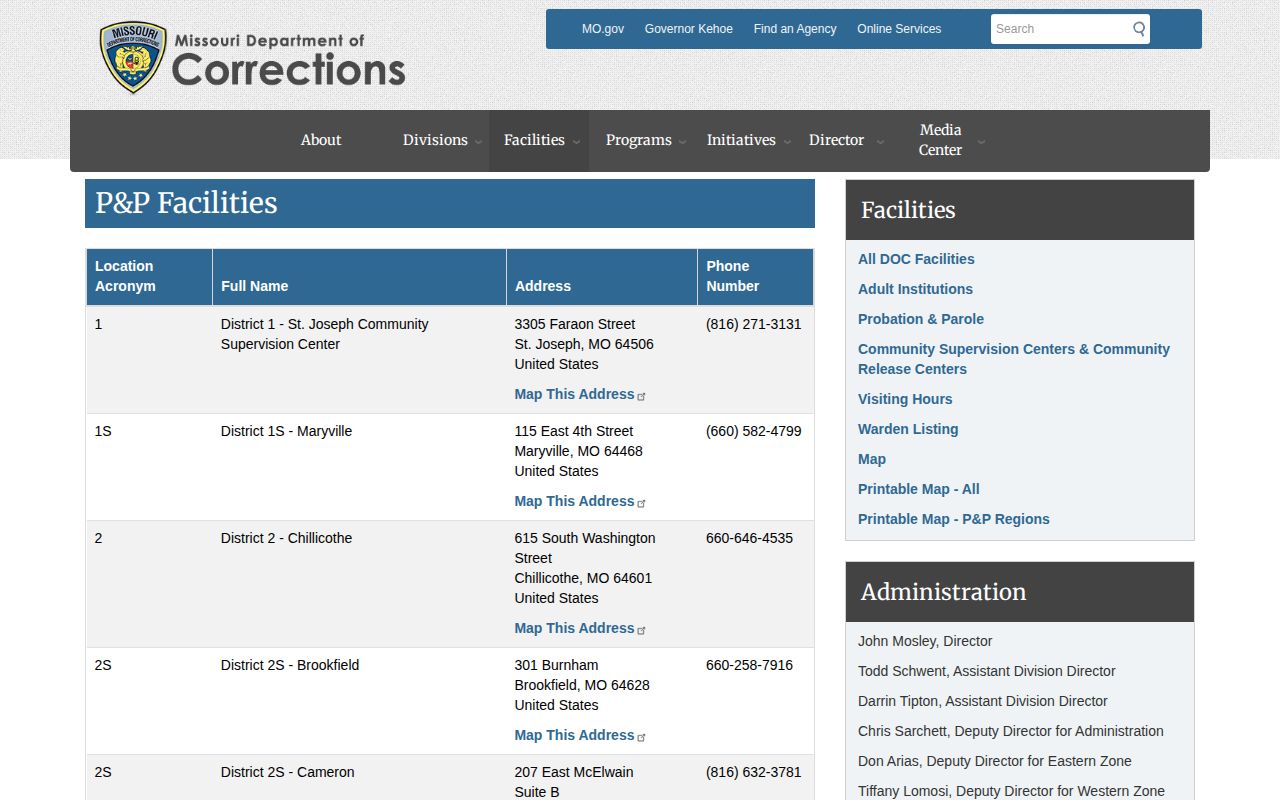
The listing is an office directory, not proof that a person is assigned to the closest district. Match the office to the person’s record before calling.
St. Louis County Pretrial Supervision
St. Louis County Justice Services has a Community Corrections division and a Pretrial Release Supervision Program. Those county services address release conditions while a case is pending. They should not be labeled parole, probation, or final discharge. A person who left the St. Louis County Jail at the Buzz Westfall Justice Center under a pretrial order can remain bound by court conditions without appearing as a MODOC parolee.
Start with the release order and the 21st Judicial Circuit or applicable municipal court record. Then use the county pretrial program page for program routing. Eligibility, reporting terms, and services must come from the individual order and program staff. The existence of the program does not establish that every released person qualifies or participates.
St. Louis Release Papers and Property
St. Louis County Policy 1420 gives unusually specific detail about what occurs as someone leaves the Justice Center. Staff identify clothing and property, reconcile funds in the person’s presence, document discrepancies, provide release papers and available medication, and may issue spare clothing when original clothing is unusable or was confiscated. Pending lost-property issues are routed to the official identified in policy.
Those documents matter beyond the exit process. Release papers can identify the destination, show whether the person went to the community or another authority, and help connect a MODOC result to the right person. They can also identify an assigned supervision office. A county final IJMS release entry proves that Justice Services processed the person out of its custody, but a release to MODOC is not a community release and is not parole.
St. Louis Violations and Warrants
No official public, name-searchable MODOC absconder list or supervision-warrant database was verified. An active field record does not prove compliance, and an absent record does not establish that no warrant exists. Section 217.720 allows Probation and Parole to issue a warrant for an alleged parole or conditional-release violation and permits return to a designated facility. A person held on such a warrant can be detained without bail while the violation process is pending.
MODOC also describes a round-the-clock Command Center that tracks designated electronically monitored or community-residential clients, investigates serious rule violations, issues certain failure-to-return warrants, and coordinates apprehension. That is operational context, not a public search portal. Status questions belong with the assigned office or an appropriate public-safety agency. Records from a field office should never be stretched into claims that the source does not make.
Missouri’s MOVANS layer can notify eligible registered victims of parole hearings, results, release to the community, escape, and other defined events. The Office of Victim Services is reached at 573-526-6516. Public VINELink participation was not authoritatively verified for the St. Louis County Justice Center, so a VINE result should always be read with its source agency and timestamp.
Final St. Louis Supervision Discharge
Leaving prison, entering parole, and completing supervision are three different events. Under § 217.730, parole time generally counts toward the sentence subject to fugitive-time rules. The Board may issue a final discharge order or certificate when the applicable obligations have been met, generally not earlier than three years after parole or conditional release unless the sentence expires sooner. The individual sentence and any other jurisdiction still control.
The best evidence combines the final certificate or order, MODOC history, and a review of every sentence row. A missing active-search result is consistent with discharge because the public search excludes discharged people, but that absence is not enough on its own. The nightly historical file can preserve completed, minimum, maximum, and supervision information after the active record disappears. A MODOC Sunshine request may be needed for the certificate or retained discharge material.
Earned compliance credits under § 217.703 can reduce the supervision term for eligible people who meet the statute. These are community-supervision credits. They are not prison good time, do not calculate a St. Louis County jail release, and do not replace a final discharge record. Confirm the actual end of supervision with the responsible MODOC office and the governing order.