
St. Louis Scheduled and Actual Release
A scheduled or projected date is a calculation based on the information available when the agency posts it. An actual release is the completed custody event. For the St. Louis County Jail at the Buzz Westfall Justice Center, the strongest local proof is the final IJMS release entry together with the bond, court order, disposition, sentence order, detainer cancellation, or other authority behind it. The destination also matters because release to MODOC, a municipality, or another agency is not release to the community.
A pretrial detainee often has no fixed date at all. Bond, a judicial decision, case disposition, a 24-hour hold, municipal wants, detainers, and warrants can control the next step. A successful county bond payment also is not an instant release. The St. Louis County bond announcement says processing can take several hours, without promising a time of day.
Find a St. Louis Projected Date
Begin by identifying the facility and legal authority. St. Louis County and the independent City of St. Louis operate separate jail and court systems. A search result for the City Justice Center does not answer a county-jail question. MODOC field offices are supervision locations, not county detention facilities, and no MODOC adult prison was verified inside St. Louis County.
- Confirm the facility address, case jurisdiction, full name, and any county inmate master number, case number, or MODOC DOC number.
- For an active state prisoner, use the official MODOC Offender Search. Compare identifiers and read the location and date labels exactly.
- For MODOC history, consult the nightly offender file and its layout. It defines minimum, maximum, and sentence-completion fields and can include people no longer in the active search.
- For a county detainee or county sentence, check Case.net or the correct court for the governing order, then ask Justice Services for the actual IJMS release record.
- Check other cases, holds, warrants, detainers, and receiving agencies. A date from one matter does not clear another authority.
- After the date passes, confirm the status with MODOC, Justice Services, or the receiving custodian rather than relying on roster absence.
The broader St. Louis County released-inmate search path shows how county, state, federal, and transfer records fit together when the destination is unclear.
MODOC Release-Date Fields
MODOC uses several terms that should not be collapsed into one date. Its nightly file calls the calculated active-sentence field “Sentence-I Minimum Release Date” and calls sentence expiration the “Sentence Maximum Release Date.” The MODOC glossary describes a “Presumptive Parole Release Date” as a tentative Board-set date dependent on suitable institutional behavior and an acceptable release plan. A minimum mandatory date marks satisfaction of a statutory bar, not necessarily the day the person leaves.
| MODOC term | What it means | Main limit |
|---|---|---|
| Minimum release date | Calculated active-sentence date in the nightly file | Other sentences, restrictions, or holds can still control |
| Maximum release date | Expiration point for the sentence record | It is not a forecast of the exact exit process |
| Presumptive parole release date | Tentative date set by the Parole Board | Behavior and an acceptable release plan remain conditions |
| Minimum mandatory date | Date a statutory service bar has been met | Meeting the bar does not itself order parole |
| Sentence completion | Historical field indicating completion for a sentence row | Every row and jurisdiction still must be checked |
The official MODOC glossary is the source for presumptive parole terminology.
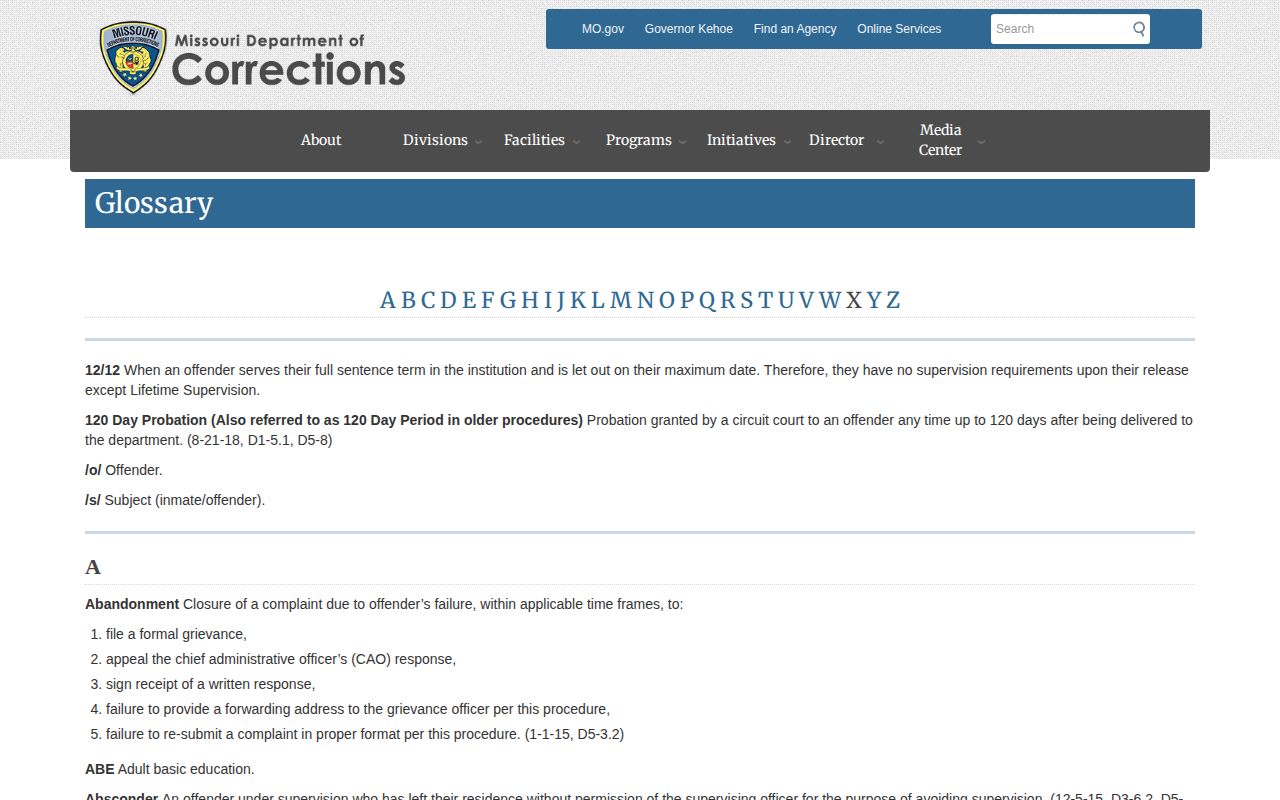
The glossary’s contingent wording is why a presumptive date should never be described as guaranteed.
St. Louis MODOC Active and Historical Records
The active MODOC search and the nightly historical file answer different questions. The active search covers people in a MODOC institution or on active field supervision. Because it excludes discharged people, it can show a move from prison to a field assignment but cannot serve as a complete list of everyone who finished a Missouri sentence. A no-result can reflect final discharge, a spelling issue, or another scope limit.
The nightly file covers people who are or have been under MODOC supervision and includes data dating as early as 1974. Its layout defines sentence minimum, maximum, and completion fields. Those rows help reconstruct state sentence history after an active profile disappears. They still are not a list of people released from the Buzz Westfall Justice Center, and they do not convert a county booking into a state-prison sentence.
When the two sources appear inconsistent, record the source date, DOC number, sentence row, and exact label. Then ask MODOC Constituent Services a clear question using the full correctly spelled name, DOC number, and birth date if available. MODOC directs specific status questions to the institutional caseworker or assigned field officer. For retained discharge evidence, a Sunshine request can seek the final discharge order or certificate and sentence-completion fields.
No St. Louis County Calculator
No public St. Louis County projected-release calculator or county good-time policy was verified. MODOC fractions and date fields must not be applied to detention at the Buzz Westfall Justice Center, Ferguson Police Correctional Facility, or Florissant Police Detention Facility. County detention turns on the order, bond, hold, sentence, or warrant governing that confinement and any demand from another authority.
Case.net can help identify the sentence or court order, but it is a judicial docket rather than a physical custody log. Justice Services maintains the county release event. Policy 1420 identifies expiration of a 24-hour hold as a release category, but it does not create a public countdown tool. Municipal charges can add another path: a person leaving county custody may be collected by a municipality rather than entering the community.
For a narrow county inquiry, provide Justice Services with the full name, approximate booking range, inmate master number or case number if known, and ask for the final IJMS release date and time, release type, authority, and destination. The county records portal routes that Sunshine request. Ask the custodian for an estimate because no flat county fee for this record was verified.
Justice Services Policy 1420 supplies the county release categories and final-release procedure. It is a procedural source, not a calculator or a person-specific release record.
Missouri Conditional Release Structure
Section 558.011 divides eligible non-dangerous felony terms into prison and conditional-release portions. The supervised portion is generally the last one-third for terms of nine years or less, three years for terms longer than nine through fifteen years, and five years for terms longer than fifteen years. These statutory divisions are state sentence rules, not a county-jail calculator.
The conditional portion can be extended through the statutory disciplinary process. MODOC also warns that program requirements can affect conditional release in specified cases. Parole can occur earlier when the governing law and Board decision permit it. Multiple sentences, consecutive terms, jail credit, and amended judgments can further change the working calculation.
A court can also act under distinct authority. Section 559.115 contains a court-authorized institutional treatment and 120-day release framework with exclusions. That route should be verified from the judgment, MODOC record, and later court entries. It does not establish a broad promise that all people are released after 120 days.
The official § 559.115 text shows the specific court-release framework.
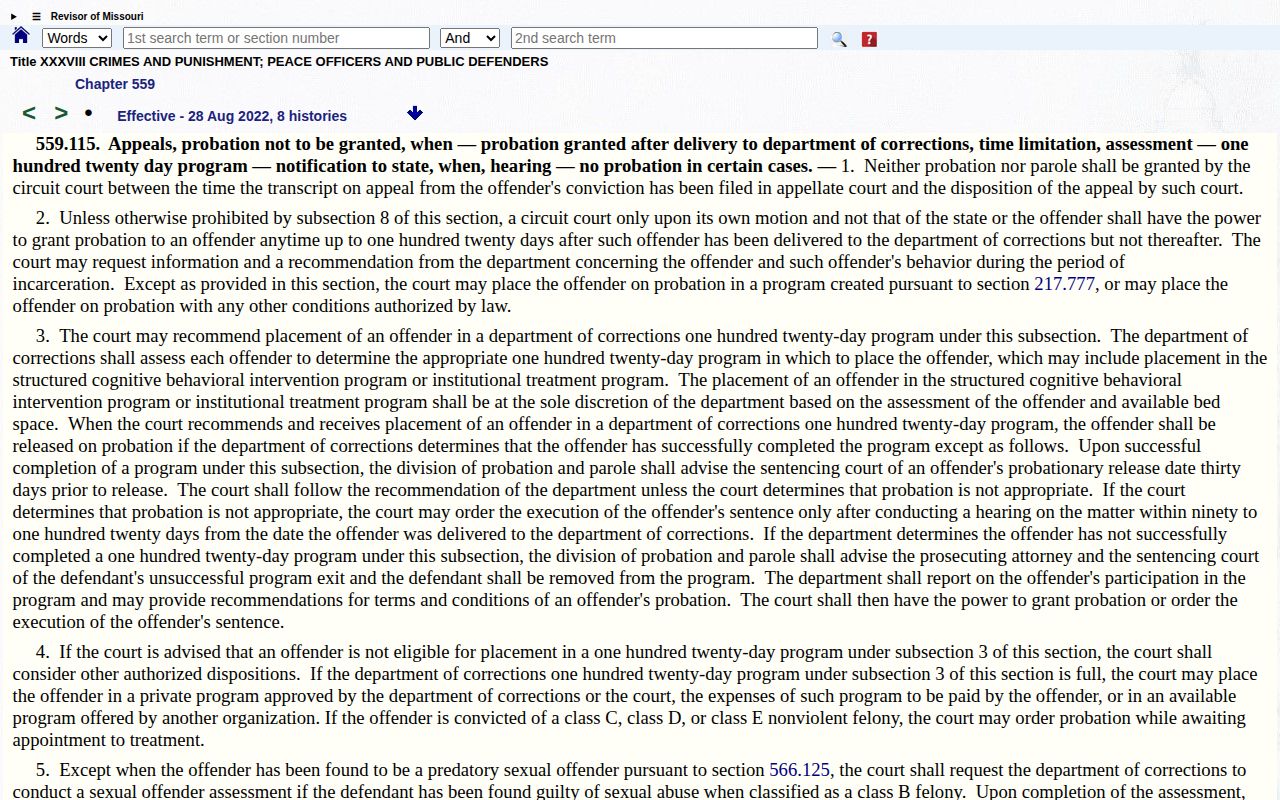
The statute’s conditions and exclusions demonstrate why the court record must be read instead of applying a one-line timetable.
Missouri Good-Time Limits
Missouri § 558.041 permits additional prison-confinement credit for eligible MODOC prisoners on the superintendent’s recommendation and under department rules. It is discretionary, applies to the current sentence, excludes statutory categories, and can be lost or rescinded. No cited rule promises a fixed number of days per month. State-prison credit also does not determine a St. Louis County jail release.
Minimum-service law also requires care. Under § 558.019, qualifying prior MODOC commitments can produce minimum terms of 40 percent, 50 percent, or 80 percent, subject to the statute’s scope and exceptions. A qualifying dangerous felony under § 556.061 generally produces an 85 percent minimum or the statute’s age-70 alternative. That is not a rule that every offense described as violent requires 85 percent.
Offense-specific law can control. Section 571.015 imposes armed-criminal-action restrictions and minimum terms. Life sentences and very long aggregate terms use statutory calculation conventions. The sentence, offense date, conviction statute, prior commitments, and sentence relationship must be checked before any percentage is used.
What Changes St. Louis Release Dates
A projected date can move because the inputs or legal authority change. Some factors alter the sentence calculation. Others do not move the date but prevent community release by sending the person to another custodian. The distinction should be stated in the final verification.
| Factor | Possible effect | Where to verify |
|---|---|---|
| Credit earned or rescinded | Can change an eligible MODOC confinement calculation | Institutional caseworker and MODOC sentence record |
| Discipline or program requirement | Can delay or extend a conditional date under governing rules | MODOC record and caseworker |
| Consecutive or multiple sentences | Another sentence may continue after one row reaches its date | Judgments and all MODOC sentence rows |
| Amended court order or jail credit | Can change the term or calculation input | Case.net, court file, and MODOC |
| Parole Board decision | Can set, defer, or deny a parole release path | Board notice and MODOC record |
| Release plan | An unacceptable plan can affect a presumptive parole date | Institutional parole officer or Board process |
| Detainer, warrant, or municipal want | Can produce continued custody or transfer instead of community release | Releasing and receiving authorities |
Confirm a St. Louis Release Event
After a projected date arrives, check the active MODOC result again. A move from an institution to a field assignment can corroborate release from prison into supervision, but parole is not final discharge. If the person is fully discharged, the ordinary active search may show nothing. Use the nightly historical file, final discharge certificate or order, MODOC inquiry, and every sentence row.
MOVANS can provide eligible registered victims with scheduled-release and release-to-community notices for MODOC events. Public VINELink coverage for the St. Louis County Justice Center was not authoritatively verified. The VINELink Inmate Search guide explains how to read the source agency and notification limits without treating a missing record as release proof.
For a county event, obtain the final IJMS release entry and authorizing paperwork from Justice Services. Note the release type and destination. A person released to MODOC, ICE, USMS, or a municipal jail has left county custody but has not necessarily entered the community. When sources conflict, preserve each agency’s timestamp and ask the custodian that physically released or received the person for the final event record.